
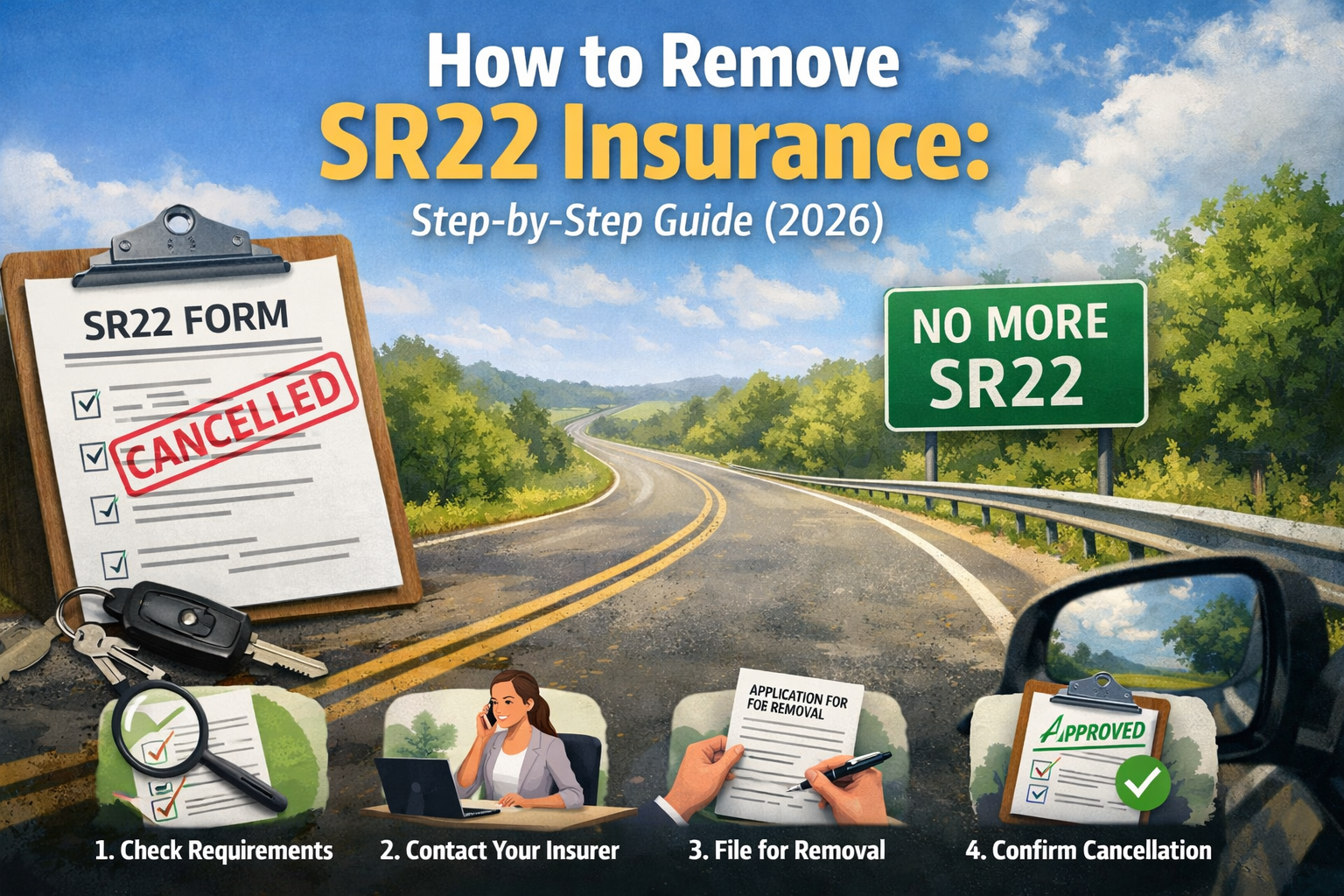
When your SR22 requirement period ends, your coverage does not automatically revert to standard insurance. You have to actively request SR22 removal — and doing it at the right time in the right way saves you money immediately. Here is exactly how.
SR22 Does Not Go Away Automatically
This is the most important thing to understand about removing SR22: your requirement period ending does not automatically remove the SR22 from your policy. If you do nothing when your requirement ends, you continue paying the SR22-elevated premium indefinitely. Your insurer has no financial incentive to notify you that your requirement has ended — they will continue collecting your higher premium until you request removal.
Many drivers pay months or even years of unnecessary SR22 premiums simply because they did not know they needed to request removal. Set a calendar reminder 60 days before your official end date so you are ready to act immediately when the time comes.
Step 1: Confirm Your Exact End Date With the DMV
Call your state DMV and ask for the specific date your SR22 requirement ends. Do not calculate this yourself — different states count the clock differently. Some count from the violation date, others from the suspension date, others from when SR22 was first filed. A few states count from the date your license was reinstated. The DMV’s official record is the only reliable source.
Write the exact date down and keep it somewhere safe. Use our SR22 duration calculator for an estimate while you wait to confirm with the DMV.
Step 2: Wait Until On or After Your Official End Date
Do not request SR22 removal even one day early. If your SR22 is removed before your official end date, the DMV will treat it as a lapse and re-suspend your license — with all the consequences of a lapse including potential clock reset in some states. You can remove SR22 the day your requirement ends or any day after.
Step 3: Call Your Insurer and Request SR22 Removal
On or after your official end date, call your insurance company and say: “My SR22 requirement with the [state] DMV ended on [date]. I am requesting that you remove the SR22 filing from my policy.” Your insurer will verify your requirement has ended — they may call the DMV directly or simply accept your confirmation — and then file an SR26 completion form with the DMV indicating your SR22 obligation has been successfully fulfilled.
Note that an SR26 for completion is different from an SR26 for cancellation. Both are called SR26 forms but they serve opposite purposes — one says your requirement was completed, the other says your coverage lapsed. Your insurer will file the correct one.
Step 4: See Your Premium Decrease at Next Renewal
Your premium decreases at your next policy renewal date after SR22 is removed — not necessarily immediately. If your renewal is 3 months away, you may continue at the current rate for those 3 months before seeing the reduction. Ask your insurer whether they can apply the rate change mid-term if your SR22 requirement ended mid-policy period.
What Happens to Your Rates After SR22 Is Removed?
Removing SR22 reduces your premium — you are no longer classified as an SR22 driver. However the underlying violation that triggered SR22 remains on your driving record and continues to affect your rates until it ages off. For DUI this is typically 5 to 10 years from the violation date. For driving without insurance it is typically 3 to 5 years.
When SR22 is removed, shop your insurance immediately. You may find significantly better rates at a different insurer for the same coverage now that the SR22 classification is gone. Switching insurers at this stage is a common way to accelerate your return to near-normal premiums. See our quote comparison guide for the process.
Frequently Asked Questions
Related Articles
This article is for educational purposes only. SR22 requirements vary by state. Always confirm requirements with your state DMV. SR22 Insurance Guide does not sell insurance.